


 Cart
Cart
 sales@molnova.com


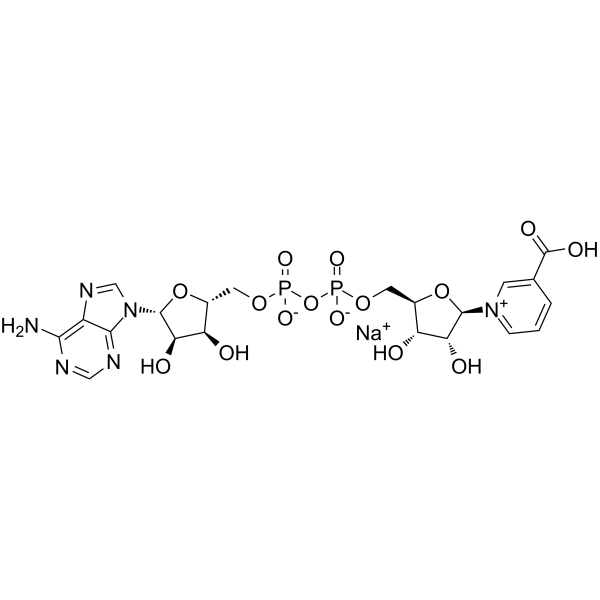
NAAD sodium salt
CAS No. 104809-30-5
NAAD sodium salt( NAAD Na salt | NAAD Na, NaAD | Deamido Nad Sodium Salt )
Catalog No. M28001 CAS No. 104809-30-5
NAAD sodium salt is a substrate of nicotinamide adenine dinucleotide synthase and can be used in studies about the specificity and kinetics of the substrate.
Purity : >98% (HPLC)
 COA
Datasheet
HNMR
HPLC
MSDS
Handing Instructions
COA
Datasheet
HNMR
HPLC
MSDS
Handing Instructions
| Size | Price / USD | Stock | Quantity |
| 5MG | 129 | Get Quote |


|
| 10MG | 192 | Get Quote |
|
| 100MG | Get Quote | Get Quote |
|
| 200MG | Get Quote | Get Quote |
|
| 500MG | Get Quote | Get Quote |
|
| 1G | Get Quote | Get Quote |
|
Biological Information
-
Product NameNAAD sodium salt
-
NoteResearch use only, not for human use.
-
Brief DescriptionNAAD sodium salt is a substrate of nicotinamide adenine dinucleotide synthase and can be used in studies about the specificity and kinetics of the substrate.
-
DescriptionNAAD sodium salt is a substrate of nicotinamide adenine dinucleotide synthase and can be used in studies about the specificity and kinetics of the substrate.(In Vitro):NAAD sodium salt, produced in the biosynthesis of NAD+ from tryptophan and NA2, was elevated from less than 20 nM to as high as 0.91 μM in peripheral blood mononuclear cells.(In Vivo):In mice, after the administration of nicotinic acid (500 mg/kg; i.p.), NAAD sodium salt is observed in kidneys, ovaries, lung, heart, and brain while after the administration of radioactive nicotinamide (500 mg/kg; i.p.), NAAD sodium salt is only in mouse liver.
-
In VitroIn peripheral blood mononuclear cells (PBMC), NAAD sodium is only expected to be produced in biosynthesis of NAD+ from tryptophan and NA2, was elevated from less than 20?nM to as high as 0.91?μM.Nicotinamide adenine dinucleotide synthetases (NADS) catalyze the amidation of nicotinic acid adenine dinucleotide (NAAD) to yield the enzyme cofactor nicotinamide adenine dinucleotide (NAD).
-
In VivoIn mice, when nicotinic acid (NA) is provided by oral gavage, liver NA peaked (340?pmol/mg) in 15?min. Hepatic NA appearance is followed by an expected peak of 220 NAAD sodium at 1?h post gavage and a rise in hepatic NAD+ from 990 baseline to 2200 at 2?h.NAAD sodium is reported in mouse liver when 500?mg/kg of radioactive nicotinamide (Nam) is injected intraperitoneally (IP) into the body cavity of mice. However, NAAD sodium is observed in kidneys, ovaries, lung, heart and brain in addition to liver in mice IP-injected with 500?mg/kg of NA but not Nam.
-
SynonymsNAAD Na salt | NAAD Na, NaAD | Deamido Nad Sodium Salt
-
PathwayOthers
-
TargetOther Targets
-
RecptorAUTACs
-
Research Area——
-
Indication——
Chemical Information
-
CAS Number104809-30-5
-
Formula Weight686.395
-
Molecular FormulaC21H25N6NaO15P2
-
Purity>98% (HPLC)
-
SolubilityIn Vitro:?H2O : 100 mg/mL (145.69 mM)
-
SMILES[Na+].Nc1ncnc2n(cnc12)C1OC(COP([O-])(=O)OP([O-])(=O)OCC2OC(C(O)C2O)[n+]2cccc(c2)C(O)=O)C(O)C1O
-
Chemical Name——
Shipping & Storage Information
-
Storage(-20℃)
-
ShippingWith Ice Pack
-
Stability≥ 2 years
Reference
1.Takahashi D, et al. AUTACs: Cargo-Specific Degraders Using Selective Autophagy. Mol Cell. 2019 Dec 5;76(5):797-810.e10.
molnova catalog



related products
-
5-Hydroxy-1,7-bis(4-...
5-Hydroxy-1,7-bis(4-hydroxyphenyl)heptan-3-yl acetate is a natural product for research related to life sciences.
-
AVP-13358
AVP-13358 is a CD23 antagonist (immunoglobulin ε-Fc receptor antagonist), an immunoglobulin E inhibitor.
-
Neoprzewaquinone A
Neoprzewaquinone A has algicidal effect on M. aeruginosa , with EC50 of 4.68 mg /L, the potential inhibition mechanisms are neo-przewaquinone A caused M. aeruginosa cells morphologic damage or lysis.
